
AI Software Factory: the power of a five-person software team.
We design and set up an AI Software Factory for your own developers. Each one gets five AI teammates and a professional setup to work in. More gets done, and every change is checked before your customers see it.
Want the prices first? See the plans- From USD 2,700One-time setup, more for bigger systems
- 5 AI teammatesPlanner, developer, reviewer, tester and fixer
- A few weeksFrom the first call to a running factory
- People decideNothing goes live without a person’s approval
Trusted by teams worldwide
-

-

-
 NordicWorkflow
-

-

-

-

-

Five AI teammates, led by a developer from your team.
Each teammate has its own job and its own tools. A developer on your side hands out the work and approves the result.
-
Splits each request into steps and plans the tests. Claude Code.
-
Writes the code and tests, and updates the docs. Claude Code.
-
Checks quality and security against your standards. CodeRabbit.
-
Uses it like a customer and reports what breaks. Playwright.
-
Fixes what failed, then runs every check again. Claude Code.
How a request becomes a release in your AI Software Factory.
Every change runs through fourteen stations in five phases. People decide at five of them, the AI teammates work at five, and scripts and GitHub run the rest. The AI never holds a write token.
-
Specify
- 1. Task formPeople decide
- 2. ReadyPeople decide
- 3. PlanAgent
- Post planScript
- 4. Plan approvalPeople decide
-
Build
- 5. BuildAgent
- Patch checkScript
- 14. PreviewGitHub runs
-
Check
- 6. Required checksGitHub runs
- 7. ReviewAgent, on green
- 8. QAAgent, on green
- RouteScript, rerun, fix or hand-off
- 9. Fix roundAgent, on red twice, or blockers
- 10. Hand-offScript, no blockers
-
Merge
- 11. ApprovalPeople decide
- 12. Merge queueGitHub runs
-
Release
- 13. ReleasePeople decide
- A person decides
- AI agent
- Scripted check
- GitHub
- No write token
- 14stations
- 5phases
- 5decisions by people
- 7rules on every change
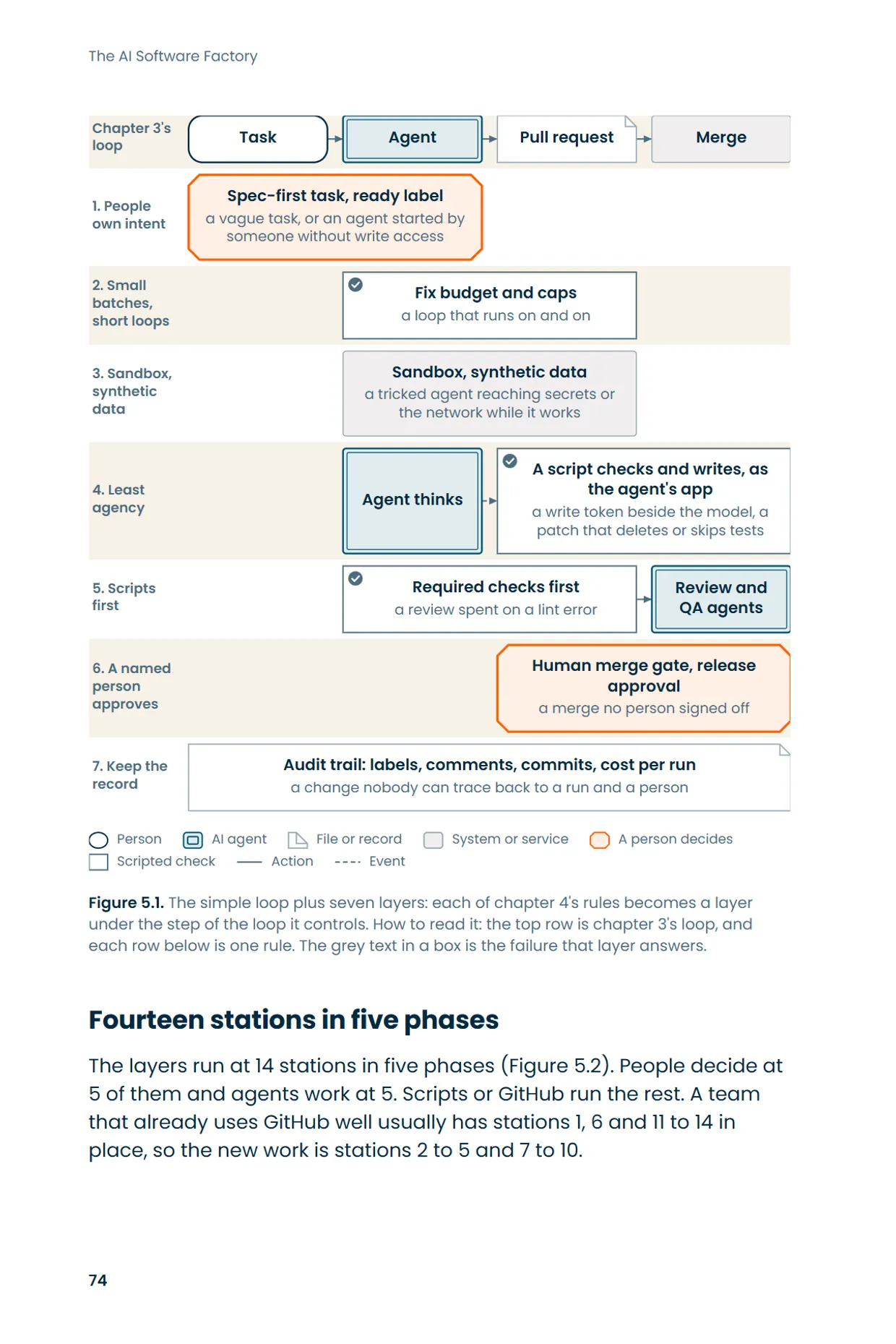
The seven rules every change follows
- 1People own intent
- 2Small batches, short loops
- 3Sandbox, synthetic data
- 4Least agency
- 5Scripts first
- 6A named person approves
- 7Keep the record
Specify
A person writes the task. On bigger tasks an AI teammate plans first, and a person approves.
Build
The developer agent builds it. A script checks the patch, and a preview shows it running.
Check
Checks run first. If they pass, the reviewer and tester start. Two fails go to the fixer.
Merge
A code owner approves, and the merge queue tests it once more before it joins the main code.
Release
A person decides when it goes into production, and every step leaves a record in GitHub.
From a first call to a running factory in a few weeks.
- 1
A 30-minute call
Tell us what you build. We’ll say whether a factory fits.
- 2
A written proposal
Your setup, the plan and the price in writing, before you sign.
- 3
Kickoff meeting
Our AI engineers map your goals, users, output and stack.
- 4
Factory design
We design the infrastructure, the flow and the architecture.
- 5
Your approval
We present the design. Nothing is built until you approve.
Start with a 30-minute call.
- Free
- No commitment
- A clear answer
- 6
We build it
We set up the environment, the agents and the workflow.
- 7
Test and tune
We test it and tune it until quality and output are right.
- 8
Handover
We hand it over, onboard your developers and train them.
- 9
Evaluation
After a while in use, we review it with you and fine-tune.
- 10
Monthly support
We keep it running and improving on a monthly plan.
Azendo delivered great service. The team developed SaaS platforms that support all-in-one digital fire safety solutions, delivering the web app alongside native iOS and Android apps. The system centralizes fire plans, drawings, legal requirements, ownership mapping, and much more. Workflows were designed around how construction teams, facility managers, and technicians actually operate on-site, streamlining what was previously scattered across paper and disconnected systems.
 Morten Kjærgaard MyrupManaging director, E-fire
We were initially skeptical about the outsourcing industry, but our experience with Azendo, along with their level of competence and professionalism, has completely changed our perspective. We have successfully collaborated with Azendo on several projects over the past 2 years.
 Adrian Ravn NielsenManaging director, NordicWorkflow NordicWorkflow
Who does what inside your AI Software Factory.
The AI teammates draft the plans, type the code, test it and fix it. Your team decides what gets built, approves the plans and chooses when a release goes live.
The AI teammates
- Draft a plan from the request
- Write the code and its tests
- Review every change for quality
- Use it like a customer would
- Fix what fails and run it again
Your team
- Decide what gets built
- Approve the plan on bigger tasks
- Read what the reviewer flags
- Sign off every merge
- Choose when it goes live
Your people stay in charge of the AI.
You decide what gets built
Every job starts with a request from your team, never from the AI.
The AI can’t go live alone
It works with test data only, and it can’t release anything by itself.
An emergency stop
One switch pauses all AI work, and your people take over from there.
A professional development environment, set up for you.
The way serious software companies work, built into your factory from the first day.
Automatic tests
GitHub Actions tests every change, and CodeQL and Dependabot scan it.
Preview links
A link to click through the new work before anyone approves it.
Staging before production
Every release runs on a staging copy of your system before production.
Approval before going live
A code owner signs off, and a merge queue tests the change once more.
Easy rollback
If a release causes trouble, you roll back to the last version.
A full history
Who changed what, who approved it and when, all kept in GitHub.
More output from the same developers, at a higher quality.
Most teams have to choose between moving fast and doing it properly. A factory is set up so you get both.
| A typical software team | With the AI Software Factory | |
|---|---|---|
| Capacity | Limited by the hours the team has | AI drafts several jobs at once while the developers review |
| Code review | Happens when someone finds the time | Every change, reviewed by AI first and then by a person |
| Testing | Often by hand, and often rushed | Automatic on every change, plus an AI that tests like a customer |
| Releases | Manual, risky and hard to undo | Tried on a safe copy first, approved, and easy to undo |
| Knowledge | Kept in people’s heads | Every plan, change and approval written down |
With the AI Software Factory.
Several jobs drafted at once, every change reviewed by AI and a person, tested automatically, released through a safe copy and written down.
A typical software team.
Capacity is the hours the team has. Reviews and tests happen when there’s time, releases are hard to undo, and the knowledge sits in people’s heads.
AI Software Factory pricing, from setup to monthly plans.
A one-time setup gets your factory built and running. Then you pick the support and building time that fits your team. The bigger the plan, the lower the hourly rate.
One-time setup
We review your current setup, or build the environment from scratch. We design a multi-agent workflow for your team and connect it to Claude Code, GitHub, staging and production. The factory comes with back-end and front-end QA checks, security isolation and a full handover to your team.
From
USD 2,700
One-time fee, based on an average 30-hour setup at USD 90 an hour. A larger or more complex system gets its price in the technical review.
Monthly plans
-
Starter
10 hours a month
USD 900
a month
USD 90 an hour
- 10 hours of support
- Upkeep and fixes
- Tweaks and AI upgrades
-
Pro
35 hours a month
USD 2,600
a month
About USD 74 an hour
- 25 hours of building
- 10 hours of support
- Support and upkeep
-
Enterprise
60 hours a month
USD 3,600
a month
USD 60 an hour
- 50 hours of building
- 10 hours of support
- Regular feature releases
-
Full-time engineer
140 hours a month
USD 4,900
a month
USD 35 an hour
- A full-time AI engineer
- For your team only
- Runs the factory daily
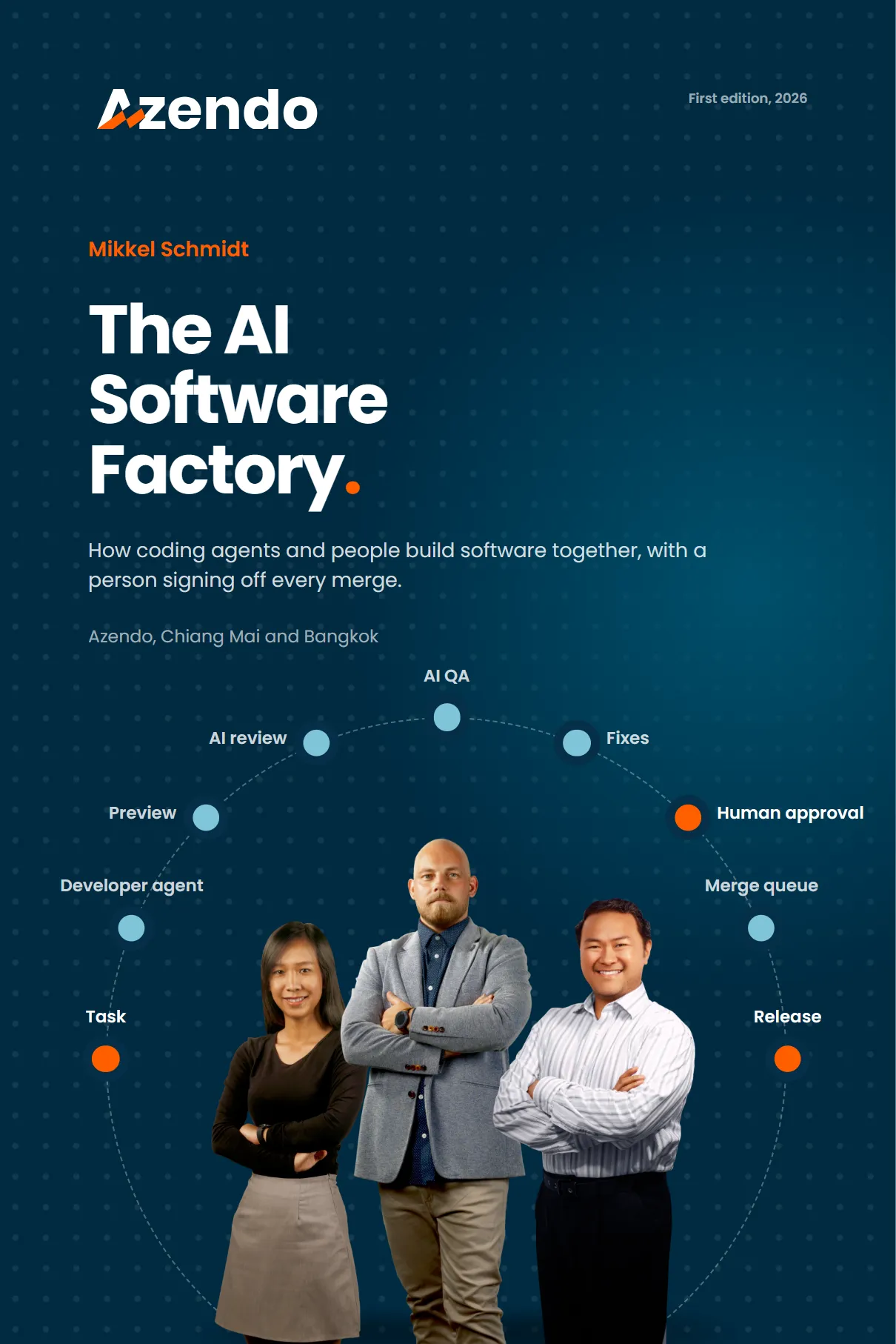
The book your factory is built on.
Mikkel Schmidt, our founder, wrote the whole method down in a 268-page book. Read it first, and you’ll know how your factory works before we build it.
- How a written request becomes a release
- A 90-day plan for rolling it out
- Online, or as a PDF download
Questions about the AI Software Factory.
What is an AI Software Factory?
A development setup where AI agents plan, write, review, test and fix code for your in-house developers. It runs inside a professional pipeline of tests, previews, approvals and safe releases, and your own people decide what gets built and what goes live.
What does the setup cost?
From USD 2,700, one time, for an average setup of 30 hours. A bigger system is priced in the technical review, and the price is in the written proposal you get before you sign.
Which monthly plan do we need?
Starter keeps the factory maintained, tuned and up to date. Pro and Enterprise add building hours, where our AI engineers take tasks and build software with you. If you want someone running the factory every day, the full-time plan assigns one of our AI engineers to your team only.
Do we need developers of our own?
The factory is built for a team with at least one developer to lead the AI teammates. Without one, the full-time plan puts our AI engineer in that seat. If you’d rather have the software built for you, that’s our AI software development services.
Which tools does the factory run on?
Claude Code plans, builds and fixes. CodeRabbit reviews, Playwright tests, and GitHub holds the code and its history, with GitHub Actions, CodeQL and Dependabot running the tests and security scans.
Can the AI put code into production?
No. A code owner approves every change before it goes live, and the AI only ever works with test data.
Start with a 30-minute call.
Tell us what you build and how your team works today. In the call we look at your goals and recommend the setup and the monthly plan that fit.
- A 30-minute call with no commitment
- A written proposal before you sign
- A reply within one business day
Loading the form…
We reply within one business day.

