
Why we run offshore development from Thailand.
Chiang Mai is five hours ahead of Copenhagen and six ahead of London. Your morning is our afternoon, which leaves a real shared working window rather than a handover note.
Three reasons an offshore development team works here, and one limitation.
The condensed version of the argument is set out as five reasons Thailand works for European roadmaps.
Why an offshore development team stays longer here
The second reason is retention. Specialists stay for years here, and in a model built on assigned teams that matters more than an hourly rate difference. Re-onboarding costs more than most rate savings.
There is a third reason that gets less attention. Thai employment costs are predictable in a way that contractor markets are not, which is what makes a fixed monthly fee possible at all. A market with high churn and rising rates cannot be priced a year ahead.
Where Thailand is the wrong answer
The honest limitation is scale. If you need forty engineers next quarter, India has depth Thailand does not, and we will tell you that rather than stretch.
If your overlap requirement is with the US west coast rather than Europe, Latin America fits better and we will say so. If the work is a six-week project, a local agency will be easier and probably cheaper. Being specific about where we do not fit is more useful than a list of strengths.
Thailand is not the cheapest offshore market and we do not pretend otherwise. For a fuller picture, including where Thailand is the wrong answer, there is a longer assessment of software development in Thailand.
Thailand's software industry is being built deliberately.
Thailand's Board of Investment isn't chasing headlines. In the first half of 2026 alone, it approved a wave of digital and AI infrastructure projects that puts the country firmly on the map as a serious technology base — not a fallback option.
Sources: Thailand Board of Investment, H1 2026 figures. The 15% market growth projection is industry analysis rather than a BOI figure.
The software engineering talent pool in Thailand.
Thailand's digital economy already accounts for more than a third of the national workforce. Universities and government-backed training programmes keep widening the pipeline of software, data and AI talent — not to catch up, but to lead the region.
That demand is exactly why we invest in our own people the way we do — see our Talent Success & Academy programme.
A description of the market itself — who builds software here and how it is structured — is covered separately under IT outsourcing Thailand.

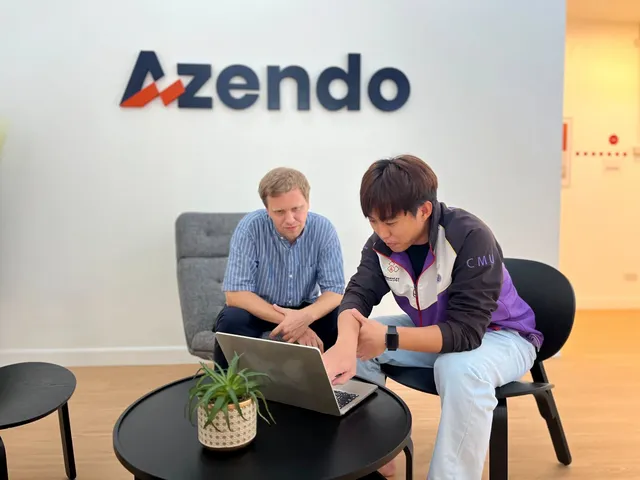
A five-hour overlap with Northern Europe.
Both of our offices in Chiang Mai and Bangkok sit five hours ahead of Northern Europe — close enough for a real overlap in the working day, far enough that Thailand's morning becomes a head start on your roadmap. Modern infrastructure and reliable connectivity mean that head start is never wasted on logistics.
More on our roots in Thailand →What an offshore development team in Thailand actually costs and delivers
Thailand sits in a narrow band that suits European companies well. Cost is meaningfully below Western Europe without the time zone penalty of cheaper markets further east, and retention is high enough that product knowledge accumulates rather than resetting every eight months.
That second point is worth more than it first appears. Replacing an engineer who leaves after eight months costs more in lost context and re-onboarding than the hourly rate difference saved by choosing a cheaper market.
The arrangement is a managed service rather than a supply of people. Azendo assigns specialists to one roadmap and keeps them there, with a dedicated software development team covering several disciplines under a single agreement where the roadmap needs it.
Location is only half the decision. The other half is what you are actually buying once you get there, and offshore staffing and managed delivery answer that differently. The committed monthly capacity behind every agreement is set out separately.