



No Results Found
The page you requested could not be found. Try refining your search, or use the navigation above to locate the post.

Role overview
The page you requested could not be found. Try refining your search, or use the navigation above to locate the post.
Offshore staffing for AI means hiring engineers, architects, or specialists based in another country who work as a dedicated part of your team. These are your people, not a third party’s. They join your standups, use your tools, report to your managers, and work exclusively on your projects.
This is different from project-based work, where you hand a deliverable to an external agency and wait for results. With staffing, you keep full control over the work and how it gets done. The international part just refers to where the people are based. The staffing partner handles the administrative side of employing someone abroad.
AI staff augmentation is a specific version of this model, where you extend an existing in-house team with international specialists rather than building something separate. A company might have a product team in London and bring in engineers from Southeast Asia to handle model development and MLOps, with both sides working toward the same goals as one team.
This model has grown more common because AI talent is genuinely hard to find in most local markets. International hiring is no longer something companies do because they cannot afford local engineers. It is increasingly the strategic choice for companies that want access to a broader talent pool and a faster path to getting the right people in place.
If you have been researching BPO or Workforce Management solutions, it is worth understanding how this model fits. Unlike traditional BPO, an external provider does not manage the process, you keep full control and direction. Unlike standard Workforce Management, which focuses on existing headcount, Azendo adds dedicated AI talent from an international market and integrates them fully into your team. Your engineers are not shared across clients. You direct the work. We handle the HR, legal, and operational infrastructure.
Why offshore AI hiring moves faster than local recruitment
The decision to bring in remote AI talent is rarely just about cost. Cost matters, but it usually is not the first reason companies make the switch. The more common driver is time: the difficulty of finding experienced engineers locally within a hiring window that does not derail a product roadmap.
In Western Europe and North America, senior engineers with real production AI experience can be difficult to find. The ones available know their market value. Salaries for mid-to-senior specialists in these markets frequently sit at a level where smaller companies simply cannot compete with larger tech firms offering higher base pay and equity. And even when you find the right person, notice periods of three months or more can push the start date far past the point where it matters.
For companies that have been through one or two failed local searches, the shift to international hiring often feels obvious in retrospect. For many, a search that takes four to six months locally completes in a fraction of that time when opened internationally. The engineers are at the same level. The work gets done the same way. The practical difference is that you are not competing against every well-funded company in your city.
For most companies that make the shift, three things change:
Time-to-hire shortens significantly. International staffing can place a vetted engineer in a fraction of the time a typical local search takes for specialist AI roles.
You access a wider talent pool. Some AI specialisations like MLOps, AI research, and certain LLM frameworks can be easier to find in markets like Southeast Asia, Eastern Europe, and Latin America than locally.
Budget goes further. A senior AI engineer in Thailand, for example, can cost significantly less than an equivalent hire in the UK or US. That saving can go toward hiring more people, covering compute costs, or giving your project more breathing room.
Most companies bringing in these engineers for the first time are surprised to find that the quality they were worried about simply is not the issue. When challenges do come up, they are usually practical: timezone overlap, onboarding, or communication tools. All manageable. The engineers are not a step down. Many have worked in international teams before and come through the same academic and industry paths as local hires.
Why companies building AI teams choose Thailand
Southeast Asia has become a well-established offshore staffing destination over the past decade, and Thailand has emerged as a practical option for companies looking to build an AI team in Thailand, particularly those based in Europe or Australia. What follows is our honest assessment of why, based on the experience of building and managing these teams on the ground.
For the companies we work with, Thailand tends to stand out not just on cost, but on a combination of factors that other markets rarely offer together: strong English communication in the tech sector, meaningful timezone overlap with Europe and Australia, stable employment infrastructure, and a growing pipeline of AI and machine learning talent with international credentials.
Bangkok and Chiang Mai have both developed into active tech hubs over the past decade. The presence of companies like Google, IBM, and Agoda has shaped a working culture where international collaboration, remote tooling, and async communication are routine which in our experience makes onboarding into distributed teams noticeably smoother.
For companies weighing up staffing options across Southeast Asia, Eastern Europe, and Latin America, Thailand tends to perform well on the factors that matter most in day-to-day execution: communication quality, technical depth in AI and machine learning, timezone fit, and the availability of experienced employer-of-record infrastructure to handle employment properly.
English fluency in Thailand’s offshore AI teams
English is widely used as a working language in Thai tech environments, especially among engineers with international degrees or experience at global companies. This matters more for AI roles than most technical positions, because the work involves documentation, model evaluation, and close collaboration with product and data teams, all of which need clear, reliable communication.
Timezone overlap for European and Australian AI teams
Thailand operates at GMT+7. For European companies, that creates a morning overlap window of two to three hours at the start of the Bangkok working day, enough for standups, sprint reviews, and real-time collaboration. For Australian companies, the overlap is even more comfortable, with several hours of shared working time across the full business day. Companies that choose to hire remote AI developers from Southeast Asia consistently find Thailand’s timezone more manageable than alternatives in Eastern Europe or Latin America.
Cost of hiring offshore AI engineers: Thailand vs the West
A senior AI engineer in Thailand typically earns considerably less than someone at the same level in the UK or US, once you account for salary and benefits. That gap is not a quality signal, it reflects cost of living, not a difference in skill or experience. For a team of three or more, it means you can build a full stack of roles, AI Architect, ML Engineers, and data support, at a budget that would cover one or two local hires in London or San Francisco.
Thailand’s tech infrastructure for remote AI teams
Thailand has a stable business environment, solid internet infrastructure in its main cities, and a growing number of staffing and employer-of-record (EOR) providers who understand how to handle international employment properly. Bangkok and Chiang Mai in particular have developed strong tech ecosystems over the last ten years, with co-working infrastructure, developer communities, and international corporate presence that support professional remote work at scale. Payroll, contracts, and local compliance all need to be in place before any real technical work can get started, and Thailand’s infrastructure makes that straightforward.
A growing AI talent pipeline
Thailand’s computer science and data science programmes have expanded significantly over the past decade. A growing share of Thai engineers hold postgraduate credentials from universities in the US, UK, Australia, and Europe, and many have returned to build careers in Bangkok or Chiang Mai. Combined with Thailand’s appeal as a destination for internationally mobile tech talent from across Southeast Asia, the result is a talent pool with real depth across AI and machine learning roles. For companies that want to build a full AI team in a single market rather than juggling hires across countries, Thailand has the range of seniority levels to make that viable.
Which AI roles can you hire through offshore staffing?
AI has split into distinct specialisations over the past few years, and knowing which role you actually need before you start saves a lot of time. For most companies, the question is not whether they need AI talent, but which role will create the most leverage first. Here is a breakdown of the main roles and when each one makes sense:
AI Engineer: the core builder. Responsible for training, fine-tuning, and deploying machine learning models into production systems. Works with frameworks like PyTorch or TensorFlow and needs to understand both the model and the environment it runs in. Best first hire for companies building an AI-powered product or integrating AI into an existing system.
AI Architect: designs the infrastructure AI systems run on tech stack, data pipelines, cloud setup, and deployment approach. Best for teams starting from scratch or scaling up, where getting the foundation wrong is an expensive fix later.
ML Engineer: the bridge between research and production. Takes models that data scientists have built and makes them work reliably in live environments, including monitoring, retraining, and MLOps pipelines. Best once you are past proof-of-concept and need things to run consistently day to day.
AI Research Scientist: for companies that need to push beyond existing tools, rather than apply them. Focused on new model architectures and experimental methods. Best when you have a strong engineering team and need someone to lead original technical work.
Prompt Engineer: designs, tests, and refines the prompts and system instructions that get consistent, safe outputs from large language models. Best when your product is built on top of models like GPT-4 or Claude and the quality of outputs directly affects user experience.
Data Analyst or Data Scientist: often the right first hire before bringing in a dedicated engineer, because the model is only as good as the data behind it. Best before you start building, when you need to understand whether and where AI will actually add value.
A useful question to ask yourself is whether the roles you are hiring for need to work closely together day to day. A team that has been built and onboarded together tends to get up to speed faster and stay more technically consistent than a group of individually sourced specialists who happen to be working on the same project.
Why companies are building offshore AI teams now
The companies bringing in overseas AI talent right now are doing it because local hiring has stalled. AI engineering roles take longer to fill than almost any other technical position. Candidates are scarce, notice periods are long, and salary expectations in Western markets have outpaced what many growth-stage companies can offer. Every month of delay is a month your product roadmap slips.
The scope of what these roles require has also expanded. Teams now need engineers who can build production ML pipelines, integrate large language models into live products, manage MLOps infrastructure at scale, and collaborate across data, product, and engineering, not just run experiments. That profile is genuinely harder to find locally, and the companies that solved it through international hiring earlier now have teams with embedded product knowledge and no recruitment lag.
Which AI staffing model fits your company
Not every company needs the same thing from AI staffing. The three main options are AI staff augmentation, building a dedicated team offshore, and a team extension. Whether you are starting from scratch or expanding an existing function, choosing the right model depends on what stage your AI function is at and how closely you need your remote engineers to work with your existing team.
Offshore AI staff augmentation
This model means bringing one or more remote engineers into an existing internal team. Your team keeps ownership and direction. The new hire fills a specific gap, whether that is model training, MLOps, data engineering, or a role like AI Architect for infrastructure decisions, without needing you to build out a whole separate management layer.
Best when: you already have internal AI leadership and a clear idea of what is missing.
Dedicated offshore AI team
This model means building a standalone group of engineers who work exclusively on your projects from another country, rather than slotting into an existing team. Companies go this route when they want to build an AI capability from scratch without opening a local office. Your leads still direct the work, but the HR, legal, and operational side sits with the staffing partner.
The main advantage is continuity. A group that stays together builds up real knowledge of your systems and product over time, something you cannot replicate with rotating contractors.
Best when: you need a self-contained AI function and do not have internal leadership already in place to direct individual hires.
Offshore AI team extension
A team extension is AI staff augmentation at scale, bringing in multiple remote roles to support a growing AI function. This is common for companies that started with one or two international hires, got good results, and are now building out a structured remote AI team. In practice it usually means adding complementary roles alongside what is already there, for example bringing in an ML Engineer to work with an existing AI Engineer, or adding a Prompt Engineer as the team’s use of LLMs grows. The result is a complete team of AI specialists covering the full stack of roles your product actually needs.
Best when: one offshore hire has already proven the model and you are ready to build the team around it.
Choosing between these models comes down to one question: do you already have internal AI leadership in place? If yes, augmentation or a team extension tends to be the right fit. If not, starting with a dedicated AI team built as a unit from the beginning usually produces better results, because the internal structure and accountability come with it.
A few things tend to go wrong with international AI team setups that do not account for this. Augmentation fails when there is no internal lead to direct the work and set priorities. Dedicated teams fail when the client tries to manage them like freelancers rather than a real team. Extensions fail when roles are added before the existing hire has properly settled. Knowing which model fits your situation upfront avoids most of these problems.
How Azendo helps you build and manage your offshore AI team
Azendo is a staffing company headquartered in Chiang Mai, with a second office in Bangkok. We specialise in building and managing embedded AI teams for companies in Europe, Australia, and beyond. Whether you need a single specialist or want to build a complete team from scratch, we handle the search, onboarding, and ongoing management. We are not a freelancer marketplace or a project agency. We hire staff on your behalf, place them in a managed environment, and handle all the HR, legal, and operational infrastructure so your team can focus on the work itself.
What sets Azendo apart is focus. We do not place accountants, support agents, or marketing staff. We work exclusively in technology, and within technology our specialisation is AI and machine learning. That means our sourcing network, our screening process, and our judgement of what good looks like in each role is sharper than a generalist firm’s. When we tell you a candidate is strong, it is because they have been assessed by people who understand the work.
We also operate differently from agencies that treat placement as the end of the engagement. Our team stays involved after the hire. We run regular check-ins with both the client and the engineer, monitor performance signals, and flag issues before they become problems. Most clients continue well beyond the initial period because once the team is embedded, replacing that continuity with repeated local hiring becomes slower and more expensive than maintaining it.
Shortlists are curated after technical and communication screening, not pulled from generic recruiter databases. For AI Engineer roles, that means tested model training ability and production experience. For AI Architect roles, it means demonstrated system design judgement. Most placements move from initial brief to someone starting within a few weeks, and most clients who start with one hire have expanded to a team within twelve months.
Here is what the process looks like in practice:
Discovery call: we learn what you are building, which roles you need, and how your internal team is structured. We are honest about whether we can help and what a realistic timeline looks like.
Candidate shortlist: we identify and screen candidates from our network. You receive a curated shortlist of people who have passed our technical and communication screening, not a stack of unfiltered CVs.
You interview and decide: you run your own interviews and make the hiring decision. We do not ask you to trust our screening blindly.
Onboarding: we handle contracts, equipment, workspace if needed, and all local HR. Your new team member starts work integrated into your tools and processes.
Ongoing management: payroll, performance support, local labour compliance, and any operational issues are handled by us. You direct the work.
For companies that want to build an offshore AI team from the ground up, we run the full process, defining roles, sourcing candidates, screening, and managing the team once they are in place. Everyone works exclusively on your projects, embedded in your tools and reporting to your leads.
For companies that already have an internal AI function and want to expand it, we help you add the right specialists for specific roles without disrupting what is already working.
What we do not do: rotate staff without notice, push unsuitable candidates to fill spots quickly, or disappear after placement. If a hire is not working within the first 90 days, we find a replacement at no additional cost. After an initial three-month period, the engagement runs monthly with no lock-in.
Frequently Asked Questions about offshore AI staffing
How quickly can I hire offshore AI engineers through Azendo?
Most placements move from initial brief to someone starting within a few weeks. Senior or more niche roles, like a senior AI Architect or an MLOps engineer, can take a little longer. Either way, we give you a realistic timeline upfront, not an optimistic one.
What does it cost to build an offshore AI team in Thailand?
It depends on role and seniority. As a rough guide, a mid-level AI engineer in Thailand typically costs significantly less all-in than an equivalent hire in the UK or US. Our pricing page has the specifics, and we are happy to put together a direct comparison before you commit to anything.
AI staff augmentation vs project outsourcing
With project outsourcing, you hand a deliverable to a third party and largely step back. You often have little visibility into who is actually doing the work or how it is being done. With AI staff augmentation, you get specific people embedded directly in your team. You manage their work, they use your tools, they join your meetings, and they are accountable to you. The staffing partner handles everything behind the scenes.
How does this differ from BPO or Workforce Management?
BPO hands a process to an external provider who manages it independently. Workforce Management focuses on optimising existing headcount. Azendo does neither: we find, employ, and support AI engineers who work exclusively for you, under your direction, as integrated members of your team with all the employment infrastructure handled on our side.
Can I hire AI team staff on a part-time basis?
Our standard model is full-time. Part-time arrangements tend to create friction in practice: split attention, weaker team cohesion, and a slower ramp-up. That said, for short bridge periods or very specific specialist needs, it can work. We will give you a straight answer on whether it actually makes sense for what you are trying to do.
How do you screen engineers before presenting them?
Every candidate goes through a technical assessment tailored to the role. For engineering roles, that covers model training, Python, and relevant ML frameworks. For architecture roles, we focus on system design and infrastructure thinking. We also assess communication and async working experience, a strong engineer who cannot communicate well remotely is not the right fit. You run your own interviews before anyone is hired.
Do I need to set up a legal entity in Thailand?
No. Azendo acts as the employer of record (EOR). We handle contracts, payroll, tax compliance, and all local HR requirements. You get the benefits of having employees in Thailand without the legal complexity of setting up a local entity yourself.
What happens if a hire does not work out?
If a placement is not working within the first 90 days, we replace the hire at no additional recruitment cost. Most early issues are resolvable with better onboarding, and we flag those proactively. If the fit is not there, we will not leave you stuck.
Is there a minimum contract length?
There is a three-month minimum from the start. This exists because it takes that long for a new hire to properly settle in and ramp up. After three months, everything rolls monthly with no lock-in.


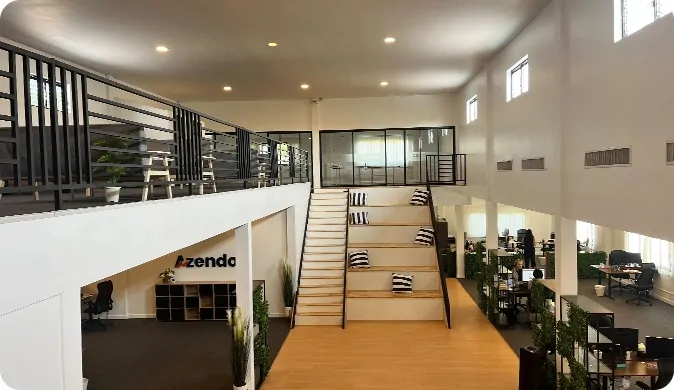
If you have read this far and are ready to hire offshore AI engineers or build your team offshore, the next step is a conversation. We will ask about your team structure, the roles you need, and what timeline you are working toward. If we can help, we will tell you exactly how. If we cannot, we will say so.
Recent hires through this model have included AI Engineers, ML Engineers, Prompt Engineers, and AI Architects for teams building internal copilots, production ML systems, and LLM-based product features. Most clients begin with one or two roles, then expand once the workflow is working.
Whether you need one engineer or a full team, we help you hire the right people and keep the structure around them working smoothly.
Finding the right people shouldn’t be a headache. As your dedicated offshore staffing partner, Azendo is here to make hiring simple, flexible, and effective. We provide a wide range of roles for our partners, ensuring you have the talent you need to succeed without the stress of traditional hiring.
No matter what specific role you are looking to outsource, we are ready to help. We know that every business is unique, which is why we don’t believe in a “one size fits all” approach. Whether you need a single specialist to help out or a full remote team to drive a major project, we support you through your entire outsourcing journey with our complete, 360-degree staffing services.
In our job index, you can browse through the many positions we are currently providing to our partners. We specialize in connecting great businesses with great people. However, our capabilities go far beyond just a list on a screen.
We are not limited to the positions you see listed. If you have a specific request or a unique need for a role that isn’t shown, we want to hear about it! We are happy to review any request for positions you are considering to outsource to an offshore staffing partner.

Offshore staffing for AI means hiring engineers, architects, or specialists based in another country who work as a dedicated part of your team. These are your people, not a third party’s. They join your standups, use your tools, report to your managers, and work exclusively on your projects.
This is different from project-based work, where you hand a deliverable to an external agency and wait for results. With staffing, you keep full control over the work and how it gets done. The international part just refers to where the people are based. The staffing partner handles the administrative side of employing someone abroad.
AI staff augmentation is a specific version of this model, where you extend an existing in-house team with international specialists rather than building something separate. A company might have a product team in London and bring in engineers from Southeast Asia to handle model development and MLOps, with both sides working toward the same goals as one team.
This model has grown more common because AI talent is genuinely hard to find in most local markets. International hiring is no longer something companies do because they cannot afford local engineers. It is increasingly the strategic choice for companies that want access to a broader talent pool and a faster path to getting the right people in place.
If you have been researching BPO or Workforce Management solutions, it is worth understanding how this model fits. Unlike traditional BPO, an external provider does not manage the process, you keep full control and direction. Unlike standard Workforce Management, which focuses on existing headcount, Azendo adds dedicated AI talent from an international market and integrates them fully into your team. Your engineers are not shared across clients. You direct the work. We handle the HR, legal, and operational infrastructure.
Why offshore AI hiring moves faster than local recruitment
The decision to bring in remote AI talent is rarely just about cost. Cost matters, but it usually is not the first reason companies make the switch. The more common driver is time: the difficulty of finding experienced engineers locally within a hiring window that does not derail a product roadmap.
In Western Europe and North America, senior engineers with real production AI experience can be difficult to find. The ones available know their market value. Salaries for mid-to-senior specialists in these markets frequently sit at a level where smaller companies simply cannot compete with larger tech firms offering higher base pay and equity. And even when you find the right person, notice periods of three months or more can push the start date far past the point where it matters.
For companies that have been through one or two failed local searches, the shift to international hiring often feels obvious in retrospect. For many, a search that takes four to six months locally completes in a fraction of that time when opened internationally. The engineers are at the same level. The work gets done the same way. The practical difference is that you are not competing against every well-funded company in your city.
For most companies that make the shift, three things change:
Time-to-hire shortens significantly. International staffing can place a vetted engineer in a fraction of the time a typical local search takes for specialist AI roles.
You access a wider talent pool. Some AI specialisations like MLOps, AI research, and certain LLM frameworks can be easier to find in markets like Southeast Asia, Eastern Europe, and Latin America than locally.
Budget goes further. A senior AI engineer in Thailand, for example, can cost significantly less than an equivalent hire in the UK or US. That saving can go toward hiring more people, covering compute costs, or giving your project more breathing room.
Most companies bringing in these engineers for the first time are surprised to find that the quality they were worried about simply is not the issue. When challenges do come up, they are usually practical: timezone overlap, onboarding, or communication tools. All manageable. The engineers are not a step down. Many have worked in international teams before and come through the same academic and industry paths as local hires.
Why companies building AI teams choose Thailand
Southeast Asia has become a well-established offshore staffing destination over the past decade, and Thailand has emerged as a practical option for companies looking to build an AI team in Thailand, particularly those based in Europe or Australia. What follows is our honest assessment of why, based on the experience of building and managing these teams on the ground.
For the companies we work with, Thailand tends to stand out not just on cost, but on a combination of factors that other markets rarely offer together: strong English communication in the tech sector, meaningful timezone overlap with Europe and Australia, stable employment infrastructure, and a growing pipeline of AI and machine learning talent with international credentials.
Bangkok and Chiang Mai have both developed into active tech hubs over the past decade. The presence of companies like Google, IBM, and Agoda has shaped a working culture where international collaboration, remote tooling, and async communication are routine which in our experience makes onboarding into distributed teams noticeably smoother.
For companies weighing up staffing options across Southeast Asia, Eastern Europe, and Latin America, Thailand tends to perform well on the factors that matter most in day-to-day execution: communication quality, technical depth in AI and machine learning, timezone fit, and the availability of experienced employer-of-record infrastructure to handle employment properly.
English fluency in Thailand’s offshore AI teams
English is widely used as a working language in Thai tech environments, especially among engineers with international degrees or experience at global companies. This matters more for AI roles than most technical positions, because the work involves documentation, model evaluation, and close collaboration with product and data teams, all of which need clear, reliable communication.
Timezone overlap for European and Australian AI teams
Thailand operates at GMT+7. For European companies, that creates a morning overlap window of two to three hours at the start of the Bangkok working day, enough for standups, sprint reviews, and real-time collaboration. For Australian companies, the overlap is even more comfortable, with several hours of shared working time across the full business day. Companies that choose to hire remote AI developers from Southeast Asia consistently find Thailand’s timezone more manageable than alternatives in Eastern Europe or Latin America.
Cost of hiring offshore AI engineers: Thailand vs the West
A senior AI engineer in Thailand typically earns considerably less than someone at the same level in the UK or US, once you account for salary and benefits. That gap is not a quality signal, it reflects cost of living, not a difference in skill or experience. For a team of three or more, it means you can build a full stack of roles, AI Architect, ML Engineers, and data support, at a budget that would cover one or two local hires in London or San Francisco.
Thailand’s tech infrastructure for remote AI teams
Thailand has a stable business environment, solid internet infrastructure in its main cities, and a growing number of staffing and employer-of-record (EOR) providers who understand how to handle international employment properly. Bangkok and Chiang Mai in particular have developed strong tech ecosystems over the last ten years, with co-working infrastructure, developer communities, and international corporate presence that support professional remote work at scale. Payroll, contracts, and local compliance all need to be in place before any real technical work can get started, and Thailand’s infrastructure makes that straightforward.
A growing AI talent pipeline
Thailand’s computer science and data science programmes have expanded significantly over the past decade. A growing share of Thai engineers hold postgraduate credentials from universities in the US, UK, Australia, and Europe, and many have returned to build careers in Bangkok or Chiang Mai. Combined with Thailand’s appeal as a destination for internationally mobile tech talent from across Southeast Asia, the result is a talent pool with real depth across AI and machine learning roles. For companies that want to build a full AI team in a single market rather than juggling hires across countries, Thailand has the range of seniority levels to make that viable.
Which AI roles can you hire through offshore staffing?
AI has split into distinct specialisations over the past few years, and knowing which role you actually need before you start saves a lot of time. For most companies, the question is not whether they need AI talent, but which role will create the most leverage first. Here is a breakdown of the main roles and when each one makes sense:
AI Engineer: the core builder. Responsible for training, fine-tuning, and deploying machine learning models into production systems. Works with frameworks like PyTorch or TensorFlow and needs to understand both the model and the environment it runs in. Best first hire for companies building an AI-powered product or integrating AI into an existing system.
AI Architect: designs the infrastructure AI systems run on tech stack, data pipelines, cloud setup, and deployment approach. Best for teams starting from scratch or scaling up, where getting the foundation wrong is an expensive fix later.
ML Engineer: the bridge between research and production. Takes models that data scientists have built and makes them work reliably in live environments, including monitoring, retraining, and MLOps pipelines. Best once you are past proof-of-concept and need things to run consistently day to day.
AI Research Scientist: for companies that need to push beyond existing tools, rather than apply them. Focused on new model architectures and experimental methods. Best when you have a strong engineering team and need someone to lead original technical work.
Prompt Engineer: designs, tests, and refines the prompts and system instructions that get consistent, safe outputs from large language models. Best when your product is built on top of models like GPT-4 or Claude and the quality of outputs directly affects user experience.
Data Analyst or Data Scientist: often the right first hire before bringing in a dedicated engineer, because the model is only as good as the data behind it. Best before you start building, when you need to understand whether and where AI will actually add value.
A useful question to ask yourself is whether the roles you are hiring for need to work closely together day to day. A team that has been built and onboarded together tends to get up to speed faster and stay more technically consistent than a group of individually sourced specialists who happen to be working on the same project.
Why companies are building offshore AI teams now
The companies bringing in overseas AI talent right now are doing it because local hiring has stalled. AI engineering roles take longer to fill than almost any other technical position. Candidates are scarce, notice periods are long, and salary expectations in Western markets have outpaced what many growth-stage companies can offer. Every month of delay is a month your product roadmap slips.
The scope of what these roles require has also expanded. Teams now need engineers who can build production ML pipelines, integrate large language models into live products, manage MLOps infrastructure at scale, and collaborate across data, product, and engineering, not just run experiments. That profile is genuinely harder to find locally, and the companies that solved it through international hiring earlier now have teams with embedded product knowledge and no recruitment lag.
Which AI staffing model fits your company
Not every company needs the same thing from AI staffing. The three main options are AI staff augmentation, building a dedicated team offshore, and a team extension. Whether you are starting from scratch or expanding an existing function, choosing the right model depends on what stage your AI function is at and how closely you need your remote engineers to work with your existing team.
Offshore AI staff augmentation
This model means bringing one or more remote engineers into an existing internal team. Your team keeps ownership and direction. The new hire fills a specific gap, whether that is model training, MLOps, data engineering, or a role like AI Architect for infrastructure decisions, without needing you to build out a whole separate management layer.
Best when: you already have internal AI leadership and a clear idea of what is missing.
Dedicated offshore AI team
This model means building a standalone group of engineers who work exclusively on your projects from another country, rather than slotting into an existing team. Companies go this route when they want to build an AI capability from scratch without opening a local office. Your leads still direct the work, but the HR, legal, and operational side sits with the staffing partner.
The main advantage is continuity. A group that stays together builds up real knowledge of your systems and product over time, something you cannot replicate with rotating contractors.
Best when: you need a self-contained AI function and do not have internal leadership already in place to direct individual hires.
Offshore AI team extension
A team extension is AI staff augmentation at scale, bringing in multiple remote roles to support a growing AI function. This is common for companies that started with one or two international hires, got good results, and are now building out a structured remote AI team. In practice it usually means adding complementary roles alongside what is already there, for example bringing in an ML Engineer to work with an existing AI Engineer, or adding a Prompt Engineer as the team’s use of LLMs grows. The result is a complete team of AI specialists covering the full stack of roles your product actually needs.
Best when: one offshore hire has already proven the model and you are ready to build the team around it.
Choosing between these models comes down to one question: do you already have internal AI leadership in place? If yes, augmentation or a team extension tends to be the right fit. If not, starting with a dedicated AI team built as a unit from the beginning usually produces better results, because the internal structure and accountability come with it.
A few things tend to go wrong with international AI team setups that do not account for this. Augmentation fails when there is no internal lead to direct the work and set priorities. Dedicated teams fail when the client tries to manage them like freelancers rather than a real team. Extensions fail when roles are added before the existing hire has properly settled. Knowing which model fits your situation upfront avoids most of these problems.
How Azendo helps you build and manage your offshore AI team
Azendo is a staffing company headquartered in Chiang Mai, with a second office in Bangkok. We specialise in building and managing embedded AI teams for companies in Europe, Australia, and beyond. Whether you need a single specialist or want to build a complete team from scratch, we handle the search, onboarding, and ongoing management. We are not a freelancer marketplace or a project agency. We hire staff on your behalf, place them in a managed environment, and handle all the HR, legal, and operational infrastructure so your team can focus on the work itself.
What sets Azendo apart is focus. We do not place accountants, support agents, or marketing staff. We work exclusively in technology, and within technology our specialisation is AI and machine learning. That means our sourcing network, our screening process, and our judgement of what good looks like in each role is sharper than a generalist firm’s. When we tell you a candidate is strong, it is because they have been assessed by people who understand the work.
We also operate differently from agencies that treat placement as the end of the engagement. Our team stays involved after the hire. We run regular check-ins with both the client and the engineer, monitor performance signals, and flag issues before they become problems. Most clients continue well beyond the initial period because once the team is embedded, replacing that continuity with repeated local hiring becomes slower and more expensive than maintaining it.
Shortlists are curated after technical and communication screening, not pulled from generic recruiter databases. For AI Engineer roles, that means tested model training ability and production experience. For AI Architect roles, it means demonstrated system design judgement. Most placements move from initial brief to someone starting within a few weeks, and most clients who start with one hire have expanded to a team within twelve months.
Here is what the process looks like in practice:
Discovery call: we learn what you are building, which roles you need, and how your internal team is structured. We are honest about whether we can help and what a realistic timeline looks like.
Candidate shortlist: we identify and screen candidates from our network. You receive a curated shortlist of people who have passed our technical and communication screening, not a stack of unfiltered CVs.
You interview and decide: you run your own interviews and make the hiring decision. We do not ask you to trust our screening blindly.
Onboarding: we handle contracts, equipment, workspace if needed, and all local HR. Your new team member starts work integrated into your tools and processes.
Ongoing management: payroll, performance support, local labour compliance, and any operational issues are handled by us. You direct the work.
For companies that want to build an offshore AI team from the ground up, we run the full process, defining roles, sourcing candidates, screening, and managing the team once they are in place. Everyone works exclusively on your projects, embedded in your tools and reporting to your leads.
For companies that already have an internal AI function and want to expand it, we help you add the right specialists for specific roles without disrupting what is already working.
What we do not do: rotate staff without notice, push unsuitable candidates to fill spots quickly, or disappear after placement. If a hire is not working within the first 90 days, we find a replacement at no additional cost. After an initial three-month period, the engagement runs monthly with no lock-in.
Frequently Asked Questions about offshore AI staffing
How quickly can I hire offshore AI engineers through Azendo?
Most placements move from initial brief to someone starting within a few weeks. Senior or more niche roles, like a senior AI Architect or an MLOps engineer, can take a little longer. Either way, we give you a realistic timeline upfront, not an optimistic one.
What does it cost to build an offshore AI team in Thailand?
It depends on role and seniority. As a rough guide, a mid-level AI engineer in Thailand typically costs significantly less all-in than an equivalent hire in the UK or US. Our pricing page has the specifics, and we are happy to put together a direct comparison before you commit to anything.
AI staff augmentation vs project outsourcing
With project outsourcing, you hand a deliverable to a third party and largely step back. You often have little visibility into who is actually doing the work or how it is being done. With AI staff augmentation, you get specific people embedded directly in your team. You manage their work, they use your tools, they join your meetings, and they are accountable to you. The staffing partner handles everything behind the scenes.
How does this differ from BPO or Workforce Management?
BPO hands a process to an external provider who manages it independently. Workforce Management focuses on optimising existing headcount. Azendo does neither: we find, employ, and support AI engineers who work exclusively for you, under your direction, as integrated members of your team with all the employment infrastructure handled on our side.
Can I hire AI team staff on a part-time basis?
Our standard model is full-time. Part-time arrangements tend to create friction in practice: split attention, weaker team cohesion, and a slower ramp-up. That said, for short bridge periods or very specific specialist needs, it can work. We will give you a straight answer on whether it actually makes sense for what you are trying to do.
How do you screen engineers before presenting them?
Every candidate goes through a technical assessment tailored to the role. For engineering roles, that covers model training, Python, and relevant ML frameworks. For architecture roles, we focus on system design and infrastructure thinking. We also assess communication and async working experience, a strong engineer who cannot communicate well remotely is not the right fit. You run your own interviews before anyone is hired.
Do I need to set up a legal entity in Thailand?
No. Azendo acts as the employer of record (EOR). We handle contracts, payroll, tax compliance, and all local HR requirements. You get the benefits of having employees in Thailand without the legal complexity of setting up a local entity yourself.
What happens if a hire does not work out?
If a placement is not working within the first 90 days, we replace the hire at no additional recruitment cost. Most early issues are resolvable with better onboarding, and we flag those proactively. If the fit is not there, we will not leave you stuck.
Is there a minimum contract length?
There is a three-month minimum from the start. This exists because it takes that long for a new hire to properly settle in and ramp up. After three months, everything rolls monthly with no lock-in.
Can offshore Docker Developer teams handle customer-facing roles effectively?Putting offshore staff in customer-facing roles worries many companies. You wonder if it works well. The right roles and preparation make offshore customer interaction successful.What makes...
What is the difference between offshore staffing and traditional outsourcing for Heroku Developer roles?Offshore staffing and outsourcing sound similar but work very differently. People use the terms interchangeably incorrectly. Understanding the difference helps you...
How do cultural differences affect communication with offshore Netlify Developer teams?Cultural differences create communication challenges offshore. What you say isn't always what they hear. Understanding cultural patterns improves collaboration dramatically.Which...
Who provides tools and software support for offshore Vercel Developer teams?Tool and software responsibility confuses companies hiring offshore. You're not sure who buys licenses and manages access. Clarifying tool support prevents gaps and inefficiencies.What tools...
How do you manage international payroll and tax withholding for offshore Cloudflare Developer teams?International payroll and taxes confuse companies hiring offshore. Different countries mean different rules. Getting payroll and withholding right prevents legal and...
How do offshore AI Integration Engineer teams build multi-agent systems for agentic ecosystems?Agent orchestration creates new complexity. Build expertise connecting multiple AI agents through Remote workforce that actually coordinate instead of chaos.What makes...

The page you requested could not be found. Try refining your search, or use the navigation above to locate the post.
Hire UX Researcher through AzendoUX Researchers investigate user behaviors and needs through systematic studies. User centered product development drives demand for offshore research expertise.What does a UX Researcher do?A UX Researcher is a specialist dedicated to...

Why Analytics Stops at Prediction and How an offshore Prescriptive Analytics Specialist HelpsPredictive models tell you what might happen. A dedicated offshore Prescriptive Analytics Specialist tells you what to do about it before the window closes.Why predictive...
The Real Cost of Bad Forecasts and How a Dedicated Offshore Predictive Analytics Specialist Fixes ItMost companies forecast with spreadsheets and call it planning. A dedicated offshore Predictive Analytics Specialist builds models that actually hold.Why bad forecasts...
Why Your Conversion Optimisation is Failing and How an Offshore Behavioral Data Analyst Fixes ItYour CRO tests move metrics but not revenue. A dedicated offshore Behavioral Data Analyst finds why users actually leave before you run another test.Why most conversion...
Hire a Dedicated Offshore Web Data Analyst in ThailandMost companies have web analytics. Few have someone whose job is using it to improve conversion. An offshore Web Data Analyst changes that.Why most analytics teams report on traffic without improving itYou have...
Why Multi-Channel Attribution is Broken and How an Offshore Digital Analytics Specialist Fixes ItPrivacy changes broke your attribution. A dedicated offshore Digital Analytics Specialist unifies fragmented channel data and builds tracking you can trust.The attribution...
Why offshore Principal AI Engineer hiring solves a problem most teams have already waited too long to fixMost AI teams discover they need a Principal engineer after the technical debt has already compounded. The hire that fixes this is a specific role. A Principal AI...

The page you requested could not be found. Try refining your search, or use the navigation above to locate the post.
Can offshore Customer Service Manager teams handle customer facing work as effectively as local teams?Doubts about offshore teams handling customers are common. The question is not whether but how to set them up for success.What doubts do businesses have when they...

How does hiring dedicated offshore PPC Specialists compare to paying local agency fees?Agency fees consume budgets while delivering limited control. Dedicated offshore PPC Specialists change the economics completely.What problems do businesses face when they hire...
How do offshore SEO Specialist teams handle AI search visibility and citation building work?AI search changes how visibility works. Offshore SEO Specialists adapt strategies for both traditional and AI-driven search effectively.What new SEO challenges do SEO...
What benefits do offshore SEM Specialist teams deliver for paid search operations?Running paid search in-house at local wages creates budget pressure. Offshore SEM Specialists change what level of expertise you can afford.What paid search limitations do SEM Specialist...
How do dedicated offshore Marketing Manager teams provide the foundation for sustainable business growth?Growth strategies need consistent marketing execution. Dedicated offshore Marketing Managers provide that foundation companies often lack.What execution gaps do...
How does offshore Copywriter staffing compare to traditional outsourcing for control, consistency, and cost?Outsourcing copywriting limits control and consistency. Offshore Copywriters give you dedicated team members at better economics.What problems do Copywriter...

Why Growing Companies Hire a Dedicated Offshore Business Data AnalystMost growing companies have data. They have CRMs, dashboards, and reporting tools. What they don't have is someone whose job is connecting that data to actual business decisions.A Business Data...
How do you onboard offshore Data Analyst teams into existing Slack and Teams workflows?Communication friction worries decision makers. Build seamless integration with proven practices through Remote workforce.What communication setup prevents friction with offshore...
How do you onboard offshore Data Analyst teams into existing Slack and Teams workflows?Communication friction worries decision makers. Build seamless integration with proven practices through Remote workforce.What communication setup prevents friction with offshore...
Why should your next Senior Data Analyst come from offshore talent markets?Senior data talent is scarce locally. Build strategic intelligence capability accessing global expertise through Remote workforce.Why is senior Data Analyst talent so scarce in local...
How do offshore Virtual Assistant teams enable business scaling without increasing operational stress through BPO?Scaling creates stress when done wrong. Offshore Virtual Assistants let you grow without growing complexity through Remote workforce.What operational...
Why the AI Technical Lead role is the coordination hire most offshore AI teams make too lateThe AI Technical Lead sits between individual contribution and team direction. Most offshore AI teams wait until delivery is visibly breaking down before making this hire. By...